Francuski zakaz waporyzatorów jednorazowych: pierwsze dane z egzekwowania i co powinni zrobić sprzedawcy w UE
What France published
France banned disposable vapes in February 2025. In October 2026 the government released its first enforcement numbers — the most detailed public data any EU member state has produced on how a disposable ban works in practice. For anyone selling or sourcing vapes in Europe, the report is worth reading, not for the headline figure but for what it says about which businesses stayed on the right side of the rules.
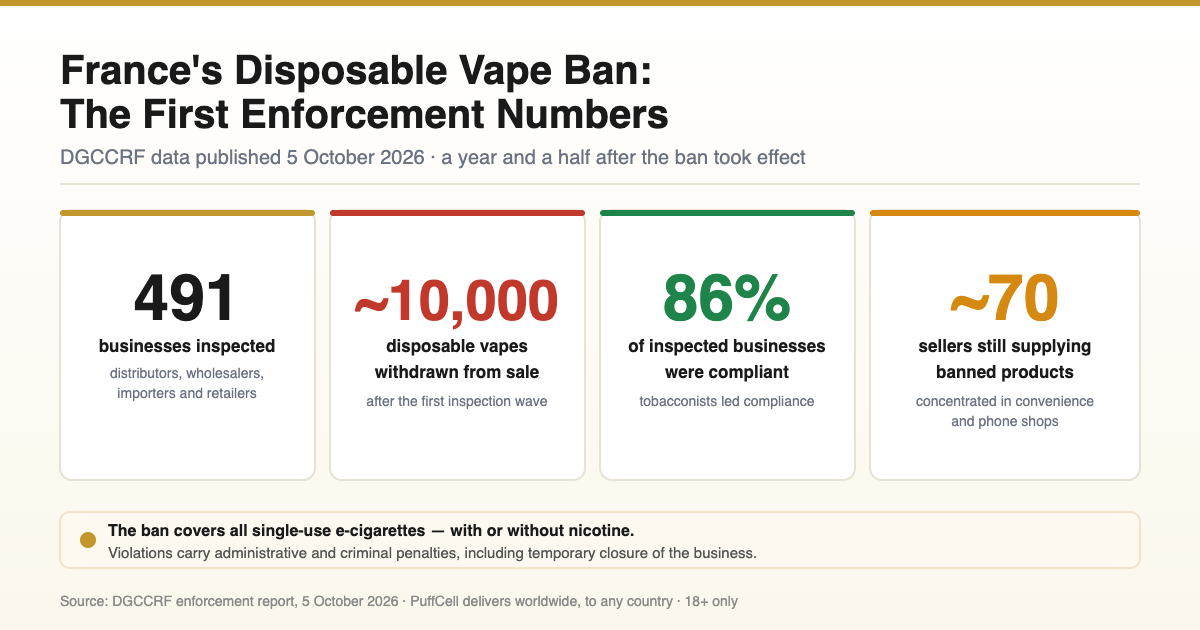
On 5 October, the DGCCRF — the French directorate responsible for competition, consumer affairs and fraud control — published the results of its first wave of inspections. Officers visited 491 businesses across distribution, wholesale, manufacturing, import and retail, and found nearly 10,000 disposable vapes still sitting at the point of sale.
The numbers
| Metric | Figure |
|---|---|
| Enforcement data published | 5 October 2026 |
| Businesses inspected | 491 (distributors, wholesalers, manufacturers, importers, retailers) |
| Disposable vapes withdrawn from sale | Nearly 10,000 |
| Inspected businesses found compliant | 86% |
| Businesses found non-compliant | Roughly 70 |
| France’s ban in force since | February 2025 |
| Scope | All single-use e-cigarettes, with or without nicotine |
| Penalties available | Administrative and criminal, including temporary closure of the business |
Two lines in that table matter to anyone planning a European order. The French ban covers nicotine-free single-use devices as well as nicotine ones, so a device’s format matters as much as its nicotine strength. And the penalty schedule includes temporary business closure — a commercial risk, not a paperwork one.
Who complied, and who didn’t
This is the part of the report wholesale buyers should read twice, because the split followed predictable lines. France’s tobacconist network largely stopped selling disposables the day the ban came into force, often with support from professional associations. The businesses caught holding banned stock clustered elsewhere: grocery stores, convenience stores and mobile phone shops — retailers without a compliance function.
The pattern holds in every market that has moved on disposables. Businesses that tracked the ban date, cleared affected stock and adjusted their range before it came into force are the ones still trading legally. Businesses that waited for enforcement to tell them did not.
A compliance checklist before you import into the EU
Most EU member states have no disposable-specific ban, so the products themselves are rarely the issue. What creates exposure is shipping the wrong product to the wrong destination, or shipping it without documentation. Five checks remove most of the risk:
- Confirm the destination’s rules before you order. Belgium, France and the UK ban single-use devices outright. The Netherlands and Denmark restrict flavours instead. The majority of member states still permit disposables under the TPD framework, but that list keeps changing — Poland, Ireland and Austria have all moved recently.
- Check device format, not just nicotine strength. Several bans cover nicotine-free single-use devices, so a zero-nicotine disposable is not automatically a compliant one.
- Hold supplier documentation. Invoices, batch records and product specifications are the first things an inspector asks for. A product without a paper trail is treated as an untraceable product.
- Keep labelling and warnings intact. TPD-mandated nicotine ceilings, health warnings and age-restriction labelling have to survive the import process. Relabelling stock to change its category is specifically under investigation in France.
- Restrict sale to adults. Every European market requires adult-only sale, at wholesale and retail alike.
The direction of travel
France is the strictest regime on the continent and it is being enforced rather than only written into law. Most EU countries have not gone that far, but the trend is towards more restrictions, not fewer. The European Commission approved Poland’s disposable ban in early October 2026, Ireland’s retail ban starts on 24 January 2027, Austria’s takes effect around the end of 2026, and eight member states sent a joint letter on 6 October asking Brussels for stricter EU-wide rules. The Commission’s TPD revision proposal is expected in December 2026.
The timeline so far
| Date | Event |
|---|---|
| Jan 2025 | Belgium’s single-use vape ban in force |
| Feb 2025 | France’s disposable ban in force (covers nicotine-free devices) |
| Jun 2025 | UK single-use vape ban in force |
| Early Oct 2026 | European Commission approves Poland’s disposable ban |
| 5 Oct 2026 | France publishes first enforcement data: ~10,000 devices withdrawn, 491 businesses inspected |
| 6 Oct 2026 | Eight EU countries demand stricter EU-wide nicotine rules |
| Late 2026 – Jan 2027 | Austria’s ban takes effect; Ireland’s retail ban starts 24 January 2027 |
| Dec 2026 | Expected: European Commission’s TPD revision proposal |
What this means if you buy elsewhere in the EU
Regulated retail is the traceable option. Products sold through legitimate channels carry TPD-mandated nicotine ceilings, warnings and labelling, and the seller can produce documentation on request. Stock that moves through informal channels routinely cannot.
PuffCell delivers worldwide, to any country. Because rules differ from country to country, check your local regulations before ordering. Our shipping policy sets out rates, delivery times and destinations, and every product we sell is restricted to adults 18 or over.
FAQ
How many disposable vapes were withdrawn from sale in France?
Nearly 10,000, according to DGCCRF data published on 5 October 2026, after 491 businesses were inspected. Around 70 of those businesses were found non-compliant.
Can you get in trouble for owning a disposable vape in France?
The ban targets sale and supply, not possession. Every enforcement action the DGCCRF has published so far has been taken against businesses, not individual users.
Which EU countries have banned disposable vapes?
Belgium, France and the UK ban single-use devices outright. The Netherlands and Denmark restrict flavours. Most other member states still permit disposables under the TPD framework, though Poland, Ireland and Austria have all introduced bans that take effect between late 2026 and January 2027.
Can I still buy disposables in other EU countries?
Yes, wherever they remain legal, and that is still most of the EU. Sales bans are in force in Belgium, France and the UK, while the Netherlands and Denmark restrict flavours. Check your local rules before ordering.
Will more EU countries ban disposables?
Several are moving that way. The Commission approved Poland’s ban in October 2026, Ireland’s retail ban starts in January 2027, Austria’s takes effect around the end of 2026, and the Commission’s TPD revision proposal is expected in December 2026.
What should a wholesale buyer check before importing into a new EU market?
Confirm the destination’s rules on single-use devices, check device format as well as nicotine strength, hold supplier documentation and batch records, keep TPD labelling and warnings intact, and restrict sale to adults. Those five checks cover the exposure the DGCCRF report identifies.