EU Vape Label Requirements: Article 20(4) Line by Line
A dieline, a leaflet proof and a print spec are on the desk, and the brand wants the same artwork in six member states this quarter. Under Directive 2014/40/EU that dieline is a regulated document: Article 20(4) fixes what must appear on the unit packet, any outside packaging and the leaflet, and what must stay off. It sits behind the six-month notification of Article 20(2), filed through the EU Common Entry Gate, and the 18+ sales rules. This guide reads EU vape labelling requirements line by line, then gives a proof-check routine to file. A buyer approving a print run is deciding whether the artwork matches the notified file.
Where Article 20(4) starts and stops
Directive 2014/40/EU entered into force on 19 May 2014 and applied from 20 May 2016. Article 20(4) splits three ways: (a) the leaflet, (b) the unit packet and any outside packaging, (c) the warning’s area by reference to Article 12(2). The Commission’s electronic cigarettes page lists the same items: a health warning, an ingredient list, nicotine-content information and a leaflet.
Three neighbouring duties get folded into artwork. Article 20(2) requires a notification six months before placing on the market in the format of Implementing Decision (EU) 2015/2183; ingredients, emissions and dose are declared there, not on the pack. Article 20(3)(b) caps nicotine at 20 mg/ml (2%); Article 20(3)(a) caps tanks at 2 ml and refill containers at 10 ml — container ceilings, not label figures. Child-resistant and spill-free construction is Article 20(3) and Implementing Decision (EU) 2016/586. EU vape advertising rules sit apart from the Article 20(4)(b)(ii) pack ban. WEEE (Directive 2012/19/EU) and batteries (Regulation (EU) 2023/1542) sit outside; confirm their dates against EUR-Lex and the Official Journal.
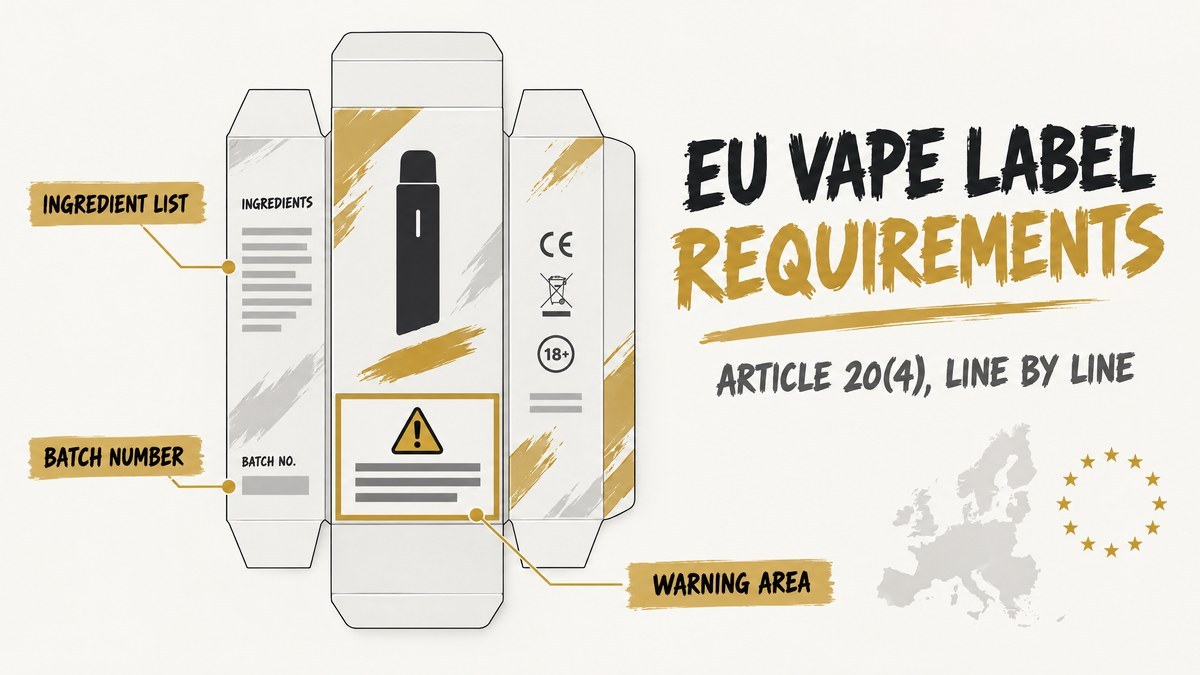
The label elements, line by line
“Unit packet” is the smallest sale pack; “outside packaging” covers every further box or sleeve, including a multipack outer. The table is the sign-off sheet for a dieline, kept beside the retailer product documentation checklist.
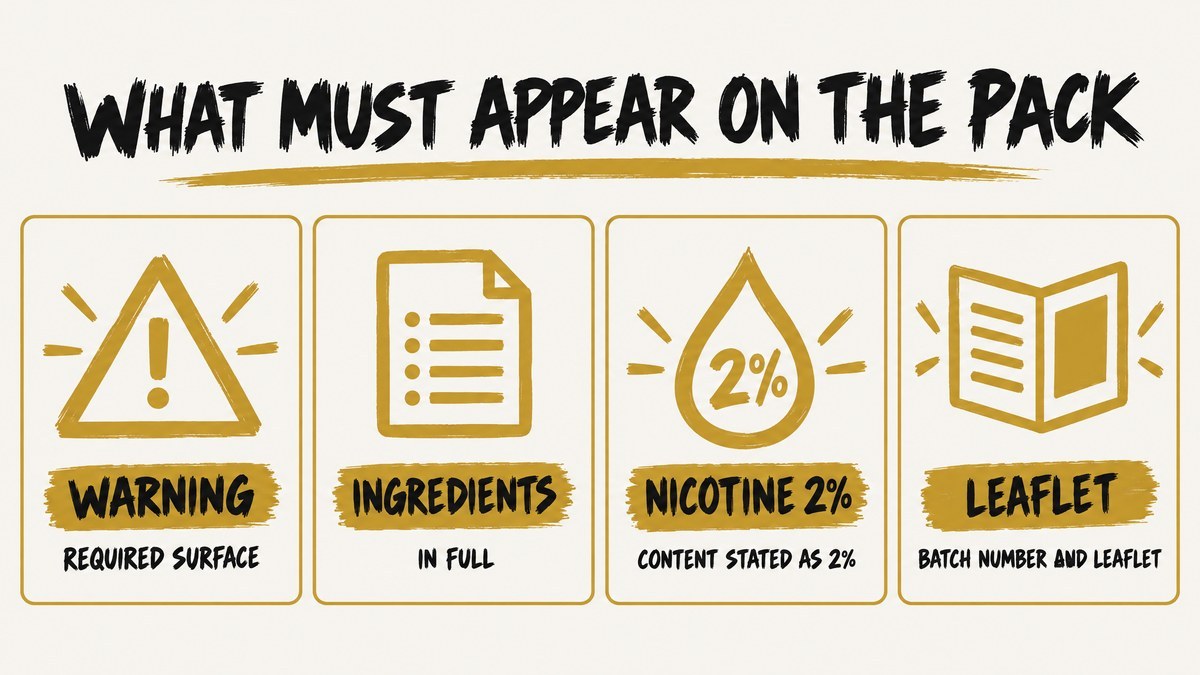
| Element | Legal basis | Where printed | Common mistake |
|---|---|---|---|
| Health warning and its area | Art 20(4)(b)(iii), (c); Art 12(2) | Two largest surfaces, inner and outer | Paraphrased wording; box under 30 %, or multilingual uplift missed |
| Full ingredient list | Art 20(4)(b)(i) | Unit packet and outside packaging | Copied from a marketing sheet, not the EU-CEG file |
| Nicotine content 2% | Art 20(4)(b)(i); 20 mg/ml (2%) ceiling in Art 20(3)(b) | Unit packet, beside delivery per dose | Percentage without delivery per dose, or strength off the notified data |
| Batch number | Art 20(4)(b)(i) | Unit packet and outside packaging | Generic lot code untied to a run or batch rotation records |
| Child-resistant closure, keep-out-of-reach wording | Art 20(4)(b)(i); Art 20(3), Decision (EU) 2016/586 | Wording on pack; physical closure on container | Wording printed, but closure not tamper-evident |
| Leaflet core information, five elements | Art 20(4)(a)(i) to (v) | Leaflet inside the unit packet | Only use instructions; contra-indications, risk groups, adverse effects, addictiveness and toxicity dropped |
| No promotional or Article 13 elements | Art 20(4)(b)(ii) | Unit packet and outside packaging | Reduced-harm claims, food imagery, vouchers retained; only factual nicotine and flavouring data excepted |
| Manufacturer, importer, EU contact | Art 20(4)(a)(vi) | Leaflet; names repeated in the dossier | Only a non-EU address, with no Union contact person |
The 2% declares content; the 2 ml and 10 ml of Article 20(3)(a) are container ceilings, never panel figures — see our compliance basics for wholesale businesses.
Reading the warning clause closely
The two permitted wordings
Article 20(4)(b)(iii) permits exactly two strings: “This product contains nicotine which is a highly addictive substance.” and the longer one adding “It is not recommended for use by non-smokers.” The member state chooses, and the text must appear in the official language or languages of the market. Freeze the exact string in the artwork and retain the selecting authority’s acknowledgement; a loose translation is not permitted.
Area, typography and placement
Article 20(4)(c) applies Article 12(2) with two adjustments: an exclamation mark may precede the wording, and the warning covers 30 % of the two largest surfaces, rising to 32 % with two official languages and 35 % with three or more. Black Helvetica bold on white, centred, parallel to the lateral edge; irremovable stickers must not hide tax stamps or tracking and tracing marks. Ask for a dieline with the reserved area in square millimetres.
An eight-step label proof self-check
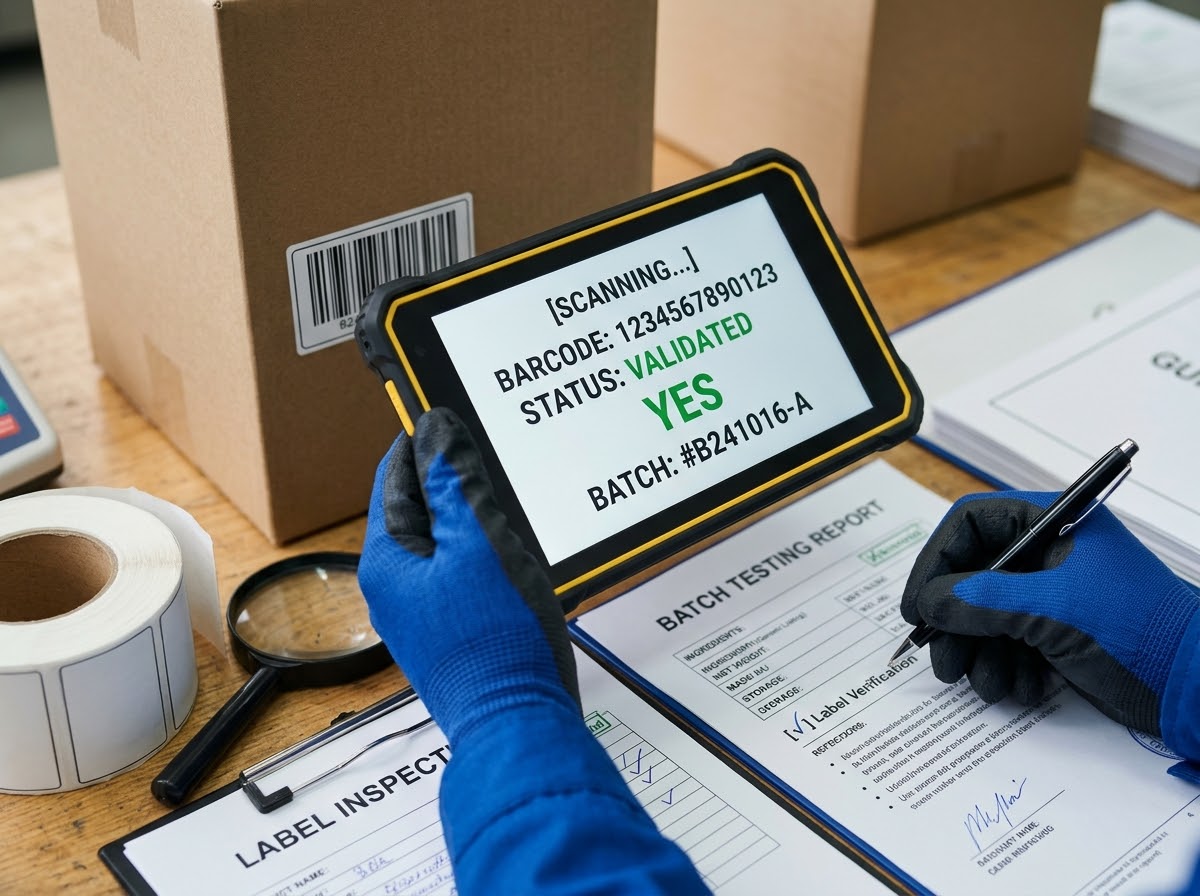
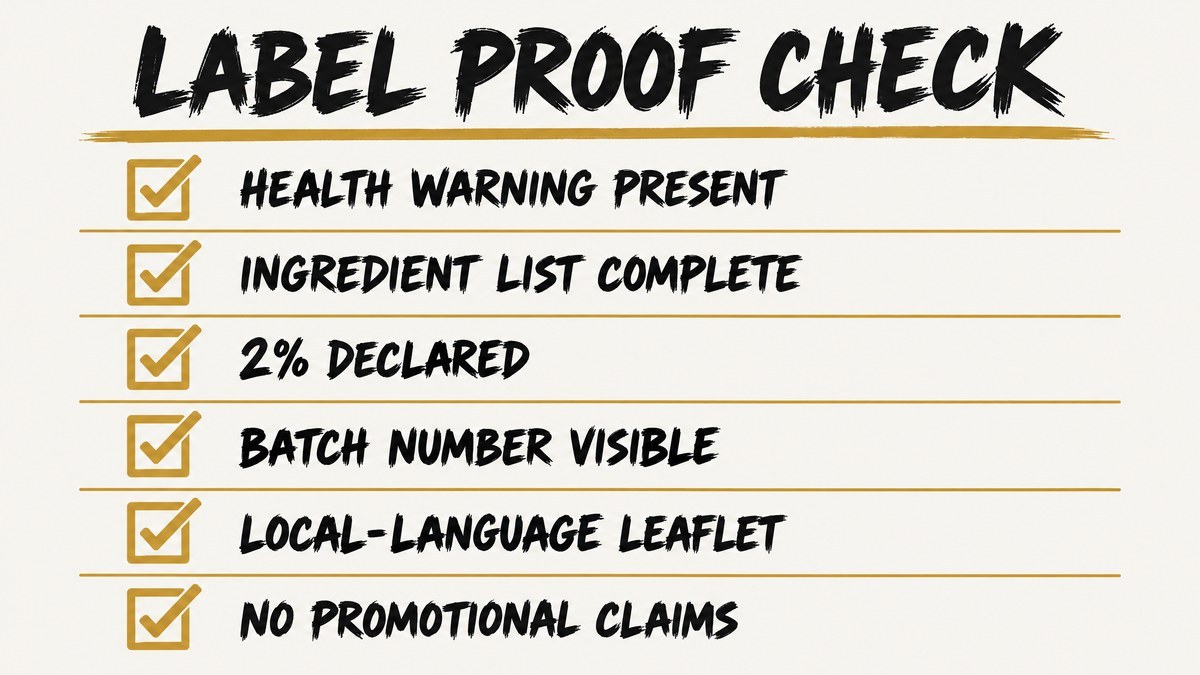
Run this on every artwork version before plate; each step ends with a named artefact.
- Step 1 — Match the artwork version to the EU-CEG submission and the Article 20(2) six-month date. Deliverable: a version log with artwork ID, submission ID, date and authorised signatory.
- Step 2 — Fix market and language. Deliverable: a country matrix naming the competent authority, the chosen Article 20(4)(b)(iii) wording and the 30 %, 32 % or 35 % area.
- Step 3 — Measure the warning box. Deliverable: a marked-up dieline PDF with the area in square millimetres and the percentage beside each warning.
- Step 4 — Set black Helvetica bold on white, centred, aligned to the lateral edge. Deliverable: a print spec sheet recording font, weight, colour and minimum type size.
- Step 5 — Reconcile the ingredient list against the EU-CEG declaration, in descending weight order. Deliverable: a signed cross-check sheet mapping each pack ingredient to its notified counterpart.
- Step 6 — Validate the 2% declaration plus nicotine delivery per dose against notified dose data. Deliverable: a dated EU-CEG excerpt stamped to the artwork version.
- Step 7 — Confirm batch number, keep-out-of-reach wording and manufacturer, importer and EU contact details. Deliverable: a batch-coding sample tied to a production lot and a contact-details sheet.
- Step 8 — Redline Article 13 features — reduced-harm claims and vouchers — keeping only the factual nicotine and flavouring data excepted by Article 20(4)(b)(ii). Deliverable: a signed proof archived with the supplier due diligence checklist.
Why one English proof does not travel
An English dieline cleared for one market will not clear the next five. Article 20(4)(b)(iii) requires the warning in the official language or languages of the member state of placement and leaves the choice between the two wordings to that state; Article 20(4)(c) lifts the area to 32 % or 35 % where two or three official languages apply, so a single-language box is undersized before translation. Member states may add a notification fee, excise duty, local-language labelling, restrictions on flavours, distance-sales restrictions and 18+ age verification. Ask each competent authority in writing which wording and languages apply, whether a fee is due and what acknowledgement is issued, then organise the replies as country annexes to one artwork programme. The Poland, Germany and Italy checklists show the pattern; the online age verification guide covers the 18+ gate.
Which documents a label revision forces you to re-take
Treat artwork as version-controlled: a revision can reach the notification itself. If it touches anything declared under Article 20(2) — ingredients, nicotine content or delivery per dose, flavourings, production process — the manufacturer or importer re-submits through EU-CEG under Implementing Decision (EU) 2015/2183 and the six-month clock runs again for the member states concerned. A move from 2% to another strength is a new product notification, not a label edit; see the 2% versus zero nicotine guide.
Re-take the following, recorded on the retailer product documentation checklist:
- A fresh EU-CEG submission and acknowledgement, with the Article 20(2) date recalculated.
- A new ingredient cross-check and nicotine declaration dated to the artwork version.
- A reprinted Article 20(4)(a) leaflet: contra-indications, risk groups, adverse effects, addictiveness, toxicity and EU contact.
- A re-measured dieline showing the 30 %, 32 % or 35 % area and an updated print spec sheet.
- A new proof sign-off and print-ready file, with the superseded version withdrawn.
- An updated supplier dossier and due diligence pack citing one artwork version.
Article 20(7) reporting and Article 20(9) adverse-effect collection keep their own cycles, with the product identifier matched to the re-notified version; see the adverse effects and recalls guide. Article 20(4) is one clause in the chain mapped by the EU vape wholesale compliance guide. For the Bang Legend 150K 6-in-1 product page, provide the version-controlled dieline, not the catalogue listing.
FAQ
Which clause sets EU vape labelling requirements?
Article 20(4) of Directive 2014/40/EU is the labelling clause: (a) the leaflet, (b) the unit packet and outside packaging, (c) the warning’s area. It entered into force on 19 May 2014 and applied from 20 May 2016. Article 20(2) requires an EU-CEG notification six months before market entry.
How large must the nicotine warning be?
Article 20(4)(c) puts the warning on 30 % of the two largest surfaces of the unit packet, rising to 32 % with two official languages and 35 % with three or more. It is black Helvetica bold on white and centred; irremovable stickers must not obscure tax stamps.
Does the 2% nicotine limit appear on the label?
The ceiling is Article 20(3)(b), capping nicotine-containing liquid at 20 mg/ml (2%). Article 20(4)(b)(i) puts nicotine content and delivery per dose on the pack, so a compliant panel states 2% beside that figure. The 2 ml and 10 ml limits in Article 20(3)(a) are container ceilings.
Can one English label cover the whole EU?
No. Article 20(4)(b)(iii) requires the warning in the official language or languages of the member state of placement and leaves the choice between the two wordings to that state. Article 20(4)(c) lifts the area to 32 % or 35 % where two or three official languages apply. One dieline fails both tests.
What must be re-issued after an artwork change?
If a revision touches information declared under Article 20(2) — ingredients, nicotine content or delivery per dose, flavourings, production process — the manufacturer or importer re-submits through EU-CEG under Implementing Decision (EU) 2015/2183 and the six-month period runs again. Re-take the ingredient cross-check, the Article 20(4)(a) leaflet and the measured dieline.
Are promotional claims banned on the pack?
Article 20(4)(b)(ii) excludes the elements in Article 13 from unit packets and outside packaging, with a narrow exception for factual nicotine-content and flavouring information. Reduced-harm claims, food or cosmetic imagery, vouchers and discounts stay off the pack. Cross-border advertising is a separate part of Article 20.
Next steps
Before the next print run, request the version-controlled dieline, the measured warning-area calculation and the EU-CEG cross-check, and file them with the retailer product documentation checklist. To have those documents reviewed against a SKU, or to obtain the current artwork for a Bang Legend 150K 6-in-1 order, contact the PuffCell EU team. Our wholesale desk works with 18+ trade buyers only.
Last reviewed: 5 November 2026
Shop the range
Looking for the devices these guides are about? These models are currently in stock and ship from our EU warehouse.